DUTCH SEPARATION / TECHNICAL GUIDANCE
Separation Equipment and Process Guide
Dutch Separation combines process engineering and modular separation equipment for industrial wastewater treatment, sludge dewatering, solids control, produced water and decommissioning water treatment. The process library includes decanter centrifuges, filter press equipment, dual cartridge filtration, chemical dosing and DutchSORB® adsorption. Each module has a specific process role; selection depends on the feed, required outlets and site interfaces. Rental availability and equipment specifications are confirmed for the project.
Published 10 October 2026 · Updated 16 October 2026 · By Dutch Separation
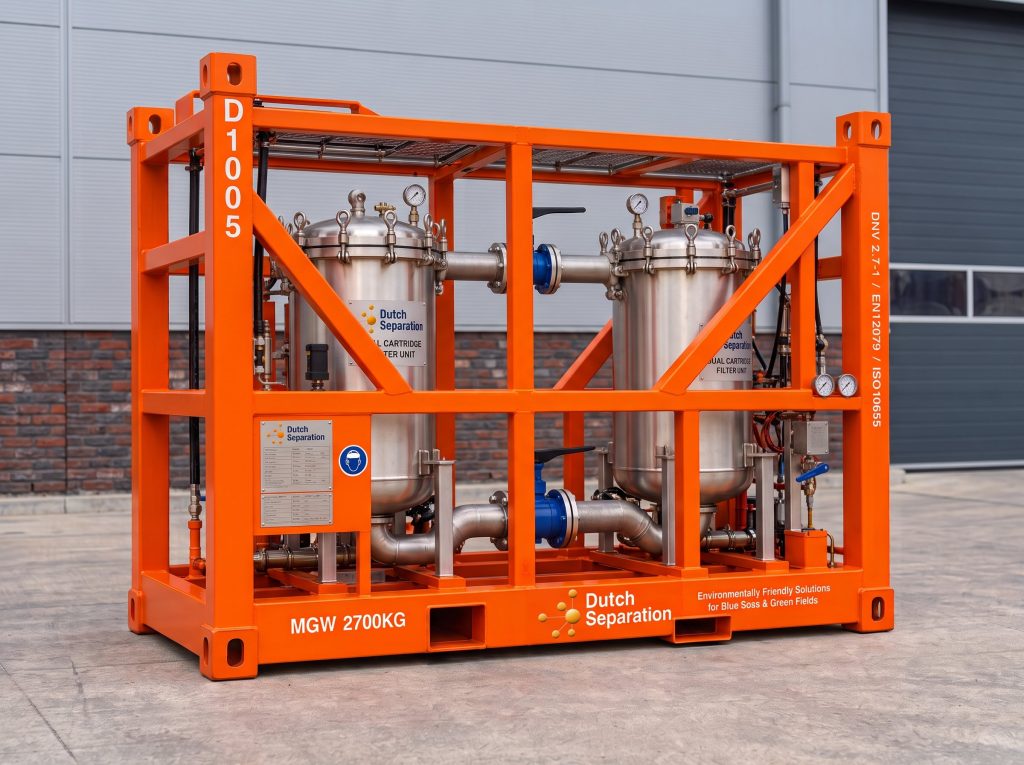
Dutch Separation dual cartridge filtration unit. Project specifications are confirmed during equipment selection.
Which separation equipment is used for sludge dewatering?
A decanter centrifuge uses a rotating bowl and scroll to separate and discharge solids from a liquid feed. Its place in a treatment train depends on the material and the required solids and liquid outlets. A concept render illustrates the modular arrangement on our website.
Sludge dewatering may use different equipment routes. Compare a decanter and filter press against representative samples, the desired cake condition and the full operating duty. Read the decanter centrifuge vs filter press guide.
Begin a separation equipment enquiry with a short duty sheet. Describe the source of the stream, minimum and maximum flow, operating hours and the required liquid and solids outlets. Include the available analysis and any variability associated with production or cleaning. This helps compare equipment routes on a consistent basis and identifies where additional sampling is useful.
When is cartridge filtration used?
Cartridge filtration removes suitable suspended particles from a liquid stream. Dutch Separation’s dual-pod unit has two stainless steel housings in an orange frame. Filter grade, fluid compatibility, operating pressure and change-out arrangements are selected for the duty. Cartridge filtration does not, by itself, establish removal of dissolved contaminants or emulsified oil.
The process flow diagram also illustrates lamella clarification after a decanter. Define the particle and settling behaviour, available flow range and target water quality before deciding how separation, clarification and filtration should be combined.
For filtration, distinguish the required outlet condition from the filter element description. Confirm how upstream solids will affect inspection and change-out, and agree where used elements will be stored and handled. Include access to the housings, isolation arrangements and the route for drains in the site review. These practical details belong in the separation equipment selection alongside the process target.
What do chemical dosing and DutchSORB® do?
Dosing and mixing are considered where conditioning forms part of the process. The illustrated concept shows polymer dosing connected to a mixing tank and an injection point. Chemical selection and dose require review of the actual stream and treatment objective.
DutchSORB® is Dutch Separation’s adsorption module family. Adsorption is considered for suitable residual dissolved contaminants after upstream solids removal. Media selection, operating duty and change-out planning depend on the actual fluid. In decommissioning water treatment, staged filtration and DutchSORB® can be assessed together for pipeline flush water and cleaning water. The project PFD distinguishes the initial contaminated-fluid phase from subsequent flush-water treatment; it is an illustrative configuration rather than a universal specification.
How is separation equipment selected?
For each selected module, agree the design duty, feed and outlet conditions, process connections, power requirements, control interfaces, access, cleaning and maintenance scope. Confirm equipment availability and the project schedule when considering rental.
Capacity, pressure limits, utility demand and certification must be confirmed against the selected equipment documentation. A concept image or model name does not establish those specifications. Read how modular wastewater treatment works.
Before a separation equipment configuration is finalised, review the complete mobilisation and operating scope. Identify responsibility for site connections, commissioning, operator familiarisation, consumables and maintenance. Agree how performance will be checked against the duty sheet and where samples will be taken. Keep the accepted equipment documentation and process diagram together for future changes to the installation.
Dutch Separation service information
Choose the service page closest to your duty: industrial wastewater treatment for water-stream treatment; sludge dewatering for a solids-rich feed; solids control for solids separation; produced water treatment for the produced-water duty; and decommissioning water treatment for asset-retirement flush water, slops and sludge. For temporary duties and trials, review separation equipment rental. Contact info@dutchseparation.com with analysis, flow and project requirements.
Explore the process.
Decanter Centrifuge vs Filter Press ↗ How Modular Wastewater Treatment Works ↗Define your separation duty.
Share the stream analysis, site location, flow range, treatment target and project duration. We will review the process requirements and identify the next step.
Discuss your separation challenge ↗