
DUTCH SEPARATION / SERVICES
Solids Control Services
Dutch Separation provides solids control services and modular solid-liquid separation for energy and industrial operations. We configure shale shakers, hydrocyclones and decanter centrifuges around the feed, process requirements and site constraints.
Discuss your project ↗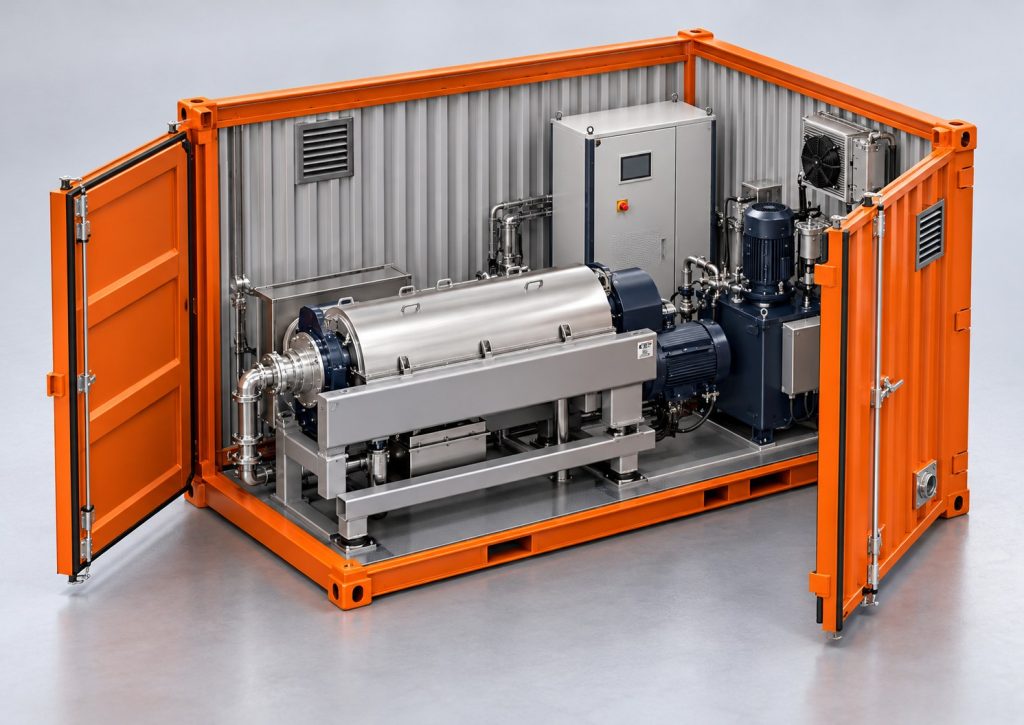
Modular decanter concept render. A decanter can form one stage of a project-specific solids-control configuration.
01 / APPLICATION
Solids control services: match each stage
Solids control is a staged process. Feed loading, particle-size distribution, fluid properties and the required separation outcome influence the equipment selection. The process review establishes what each stage needs to remove and how the remaining stream moves to the next operation.
The application may involve a drilling-related fluid or another industrial slurry. Coarse solids removal, finer-particle separation and management of the liquid fraction need to be considered together. The configuration should also account for variation in the feed rather than only a single nominal operating point.
02 / EQUIPMENT
Shale shakers, hydrocyclones and decanters
A shale shaker screens the feed according to the selected mesh and operating conditions. Hydrocyclones separate particles through a different mechanism and need a suitable feed arrangement. A decanter centrifuge can provide a further solid-liquid separation stage where it fits the material and treatment duty.
These technologies are not interchangeable in every application. Dutch Separation’s process engineering approach defines their roles, sequence and interfaces, including feed pumping, collection and the handling of separated solids. The final equipment selection follows the project requirements.
03 / PROJECT DELIVERY
Connect the process to the site
A workable solids-control system depends on physical layout, utilities, flow routing and operating responsibilities. We define process connections and control interfaces so that the selected modules can operate as part of the surrounding installation.
Supply or rental, commissioning and support are scoped for the project. Begin with the material description, expected flow and solids loading, operating hours and desired outcome. Where necessary, further analysis or trials can inform the equipment configuration before deployment.
Solids Control Services: project questions
What is the difference between solids control and sludge dewatering?
Solids control manages solids within a liquid process stream, often through several separation stages. Sludge dewatering focuses on concentrating a solids-rich stream. The duties can overlap but need different process objectives.
Can modules be added if the duty changes?
The modular approach allows additional process steps or capacity to be considered. Hydraulic capacity, utilities, controls and site space must be reviewed before modules are added.
What performance information should an enquiry include?
Include feed flow, solids concentration and particle-size information where available, fluid properties, operating hours and the required outlet condition. Describe any expected changes in the feed.
How are solids control services planned for a changing feed?
Solids control services should account for expected variation in flow, solids loading and particle size. Identify which changes occur during normal operation and which are occasional events. Review the effect on feed pumping, screening, collection tanks and downstream separation. Agree the operating information that will be recorded so that the team can assess changes consistently. The process configuration should define how separated solids and liquid will be handled at each stage.
What interfaces matter for a solids-control installation?
The scope of solids control services should identify connection sizes, flow routing, electrical supply, controls and the boundary with existing equipment. Include transport access, lifting arrangements, maintenance space and the route for removed solids. A layout and process diagram help show where each module sits and which party provides tanks, pumps and interconnecting pipework. Resolving these interfaces before mobilisation supports a clearer commissioning plan and avoids assumptions about the surrounding installation.
Connected capabilities.
SEPARATING COMPLEXITY. DELIVERING CLARITY.
Tell us about your stream.
For solids control services, share the material, location, required capacity, project duration and desired outcome. We will review the process requirements and define the next step.
Discuss your separation challenge ↗ info@dutchseparation.com