DUTCH SEPARATION / SERVICES
Industrial Wastewater Treatment
Dutch Separation configures industrial wastewater treatment systems around your water analysis, required outlet quality and site conditions. Our modular approach combines process engineering with the required separation, clarification, filtration and DutchSORB® adsorption stages for a defined treatment duty.
Discuss your project ↗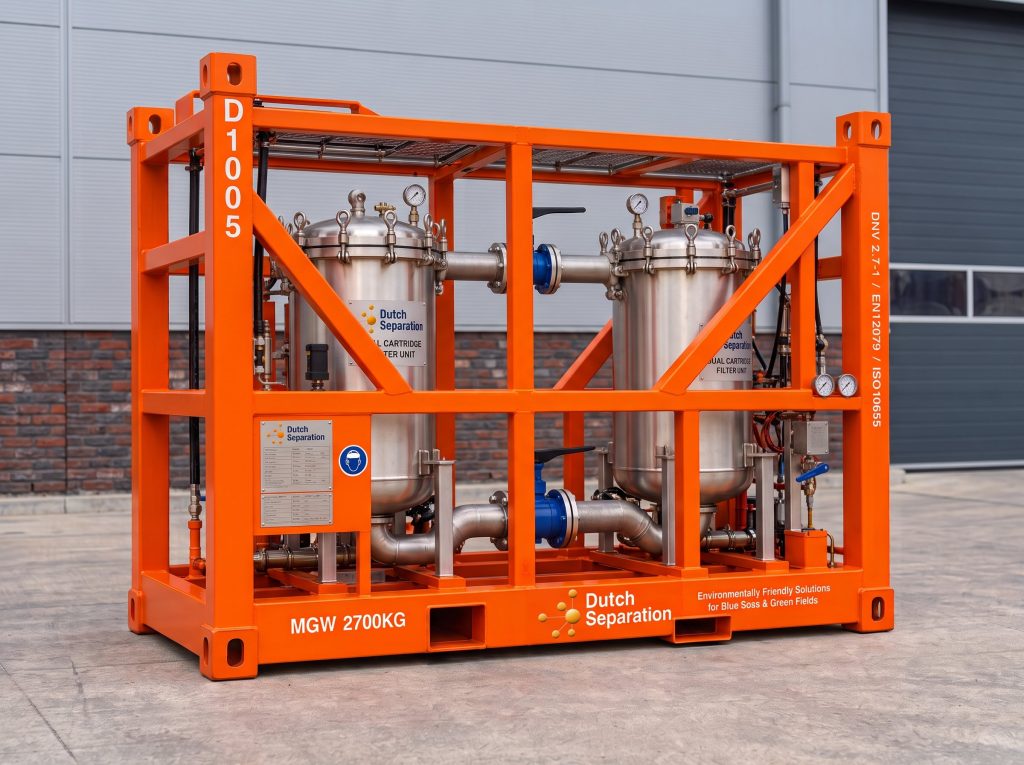
Dutch Separation dual cartridge filtration unit. Equipment selection depends on the water stream and treatment objective.
01 / APPLICATION
Treatment for process water, cleaning water and slops
Industrial wastewater streams can contain suspended solids, fine particles, oil and dissolved contaminants. Process water, cleaning water and slops may need different treatment routes even when they originate on the same site. Identify each source and its variability before deciding whether streams should be combined or treated separately.
Define the next destination: reuse in a process, transfer to a downstream treatment stage or an agreed discharge route. Set the water quality target and sampling method for that destination. Pipeline flush water and slops during asset retirement are covered in our decommissioning water treatment approach.
02 / EQUIPMENT
Clarification, filtration and adsorption
Review chemical dosing and mixing, decanter separation, lamella clarification, cartridge filtration and DutchSORB® adsorption as individual unit operations. Solids separation and filtration address suitable particulate material; adsorption is considered for suitable residual dissolved contaminants. The feed chemistry and treatment target determine which stages are required.
Our illustrated concept connects mixing and polymer dosing with pumping, a decanter centrifuge and a lamella clarifier. It explains the process interfaces rather than specifying one package for every stream. See how modular wastewater treatment works for the configure, connect, scale and redeploy approach.
03 / PROJECT DELIVERY
From process review to project handover
Start with a process review, then define equipment duties and physical, process, power and control interfaces. Agree the responsibilities for supply or rental, site preparation, commissioning, sampling and operational support. Include the route for separated solids, spent cartridges and adsorption media in the scope.
For projects in the Netherlands, begin with the site location, stream analysis, required flow, operating hours and treatment target. These details help establish a practical configuration and identify what further sampling or trials are needed before committing to equipment.
Industrial Wastewater Treatment: project questions
What information is needed to select a treatment system?
Provide representative analysis, water sources, average and peak flow, total volume, temperature, pH and expected variations. Identify known oils, solids and process or cleaning chemicals. Include the required outlet quality, sampling arrangements, available utilities, footprint and the project programme. The team can then identify missing information or trial requirements.
Can the system be configured for temporary treatment?
A modular approach can support a temporary or changing duty. Rental suitability and equipment availability are reviewed against the proposed operating conditions and project schedule.
Is wastewater treatment the same as sludge dewatering?
Wastewater treatment focuses on the water stream and its quality. Sludge dewatering concentrates a solids-rich stream. A treatment train may need both, with a defined route for the separated solids and liquid.
What should an industrial wastewater treatment enquiry include?
For an industrial wastewater treatment review, describe normal operation as well as start-up, shutdown and occasional peak loads. Identify the source of each water stream and whether they are mixed before treatment. Include existing tanks, pumps and available connection points. A layout or process flow diagram helps the team understand space constraints and where samples can be taken. This information supports a more focused discussion of treatment stages, interfaces and the responsibilities of each party.
How is a treatment configuration assessed before mobilisation?
Agree an assessment plan covering inlet and outlet samples, analytical methods, flow and the operating period. Review whether a laboratory test or practical trial is needed before final selection. Define how changing feed conditions and off-specification water will be managed. Confirm the destination of treated water and residual waste with the project team; equipment selection alone does not establish discharge approval.
Connected capabilities.
SEPARATING COMPLEXITY. DELIVERING CLARITY.
Review your industrial wastewater treatment requirements
Send the water analysis, flow range, operating pattern, site location and required outlet quality. Include a layout or process flow diagram if available. We will review the treatment stages, identify sampling or trial needs and define the next step for your project.
Discuss your separation challenge ↗ info@dutchseparation.com