DUTCH SEPARATION / DECOMMISSIONING
Offshore Decommissioning Water Treatment
Dutch Separation provides decommissioning water treatment for pipeline flush water, platform cleaning water, slops and sludge. We combine process engineering, staged filtration and DutchSORB® adsorption in modular treatment trains, selected around the fluid analysis, project phases and offshore site constraints.
Discuss your decommissioning project ↗Separating Complexity. Delivering Clarity.
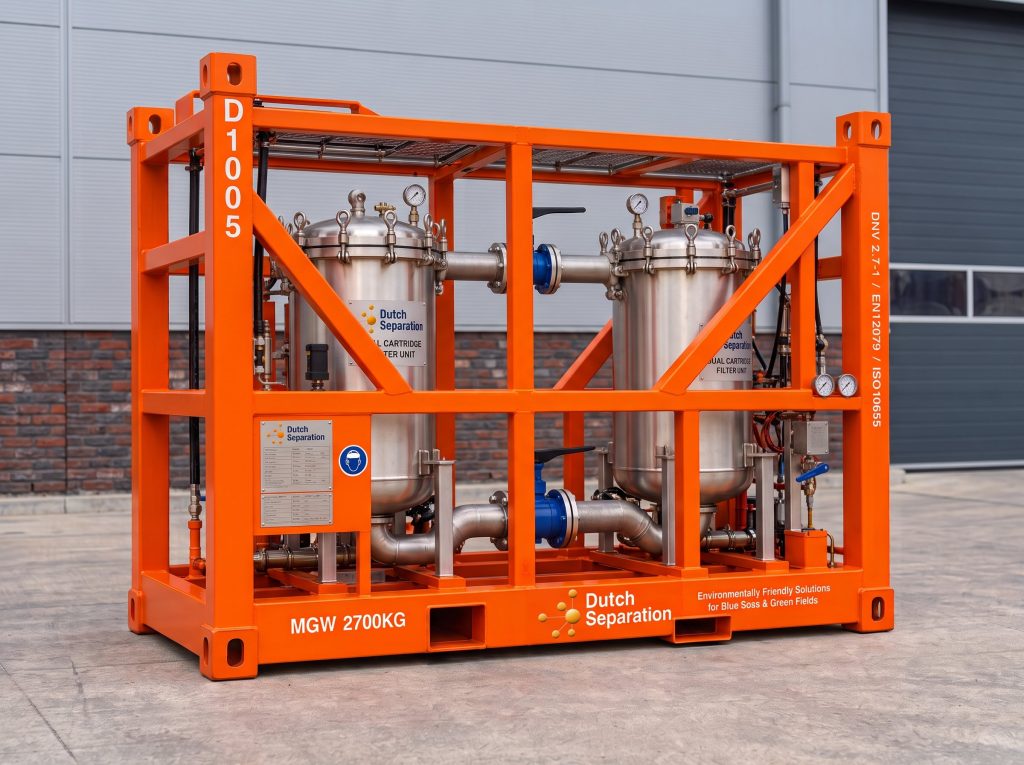
Dutch Separation dual cartridge filtration unit. The final package depends on fluid analysis, site constraints and the required treatment duty.
01 / THE DUTY
Decommissioning water treatment for pipeline flushing, slops and sludge
Pipeline flushing and pigging can release suspended solids, residual hydrocarbons and deposits into large volumes of water. Platform cleaning and plug and abandonment (P&A) support can add slops, tank residues and semi-liquid sludge. Define a treatment route for each stream, with an agreed destination for treated water and recovered waste.
Pipeline flushing and pigging
Plan treatment around the initial contaminated flush and the subsequent water volume. Review suspended solids, residual hydrocarbons, deposits and the expected changes during pigging. Separating these duties helps define feed storage, filtration stages, peak flow and the route for each recovered fraction.
Platform cleaning and slops
Review cleaning chemicals, salinity and the form of the oil before selecting treatment. A dual cartridge filtration skid can remove suitable suspended particles and protect downstream media. Emulsified oil may need pretreatment; cartridge filtration alone is not a complete solution for every slops stream.
Sludge and solids management
Where the duty requires it, combine sludge dewatering with downstream water treatment. Segregate recovered solids and spent consumables for the agreed waste route.
02 / THE TREATMENT TRAIN
A staged filtration and adsorption process
Offshore decommissioning water treatment can start with a solids-heavy initial flush and continue with a larger, less contaminated water volume. Configure each phase around its own duty while retaining clear transfer, sampling and waste-handling interfaces.
01
Characterise
Provide representative samples from each expected phase, total water volume, average and peak flow, temperature and the treatment target. Identify solids, hydrocarbons, salinity and cleaning chemicals so the proposed equipment and consumables suit the fluid.
02
Separate
Use screening and staged cartridge filtration to reduce particulate loading. Add decanter separation where the solids concentration and fluid behaviour justify it.
03
Polish
Consider DutchSORB® adsorption for suitable residual dissolved contaminants. Arrange vessels in series for staged treatment or parallel where the design requires additional capacity.
04
Verify
Define inlet, interstage and outlet sampling before mobilisation. Record treated volume, flow and differential pressure alongside the agreed laboratory results. Establish who accepts the treated water and how off-specification water is retained or returned for further treatment.
Illustrative treatment sequence. Vessel size, filtration grade, operating pressure and achievable outlet quality require project-specific selection and validation.
03 / BUILT AROUND YOUR SITE
Modular equipment with defined interfaces
A decommissioning water treatment package combines the required unit operations with the transfer arrangements that make them usable on site. Review pumps, manifolds, hoses, feed and discharge connections alongside space, access, utilities and lifting requirements. The process flow diagram below separates the initial contaminated-fluid phase from subsequent flush-water treatment.
For initial contaminated fluids, the illustrative PFD shows bulk filtration followed by two parallel staged cartridge-filtration branches. For subsequent flush water, it shows three parallel filtration trains, each followed by DutchSORB® adsorption. These are sequential project phases, not a requirement to send every stream through every stage. Final equipment selection depends on representative samples and the agreed outlet specification.
Our modular treatment platform allows configurations to change between project phases. Series stages provide successive treatment; parallel trains can accommodate additional duty. Include safe isolation, cartridge replacement, media management and controlled draining in the design. Review separation equipment rental, commissioning and operational support within the agreed scope.
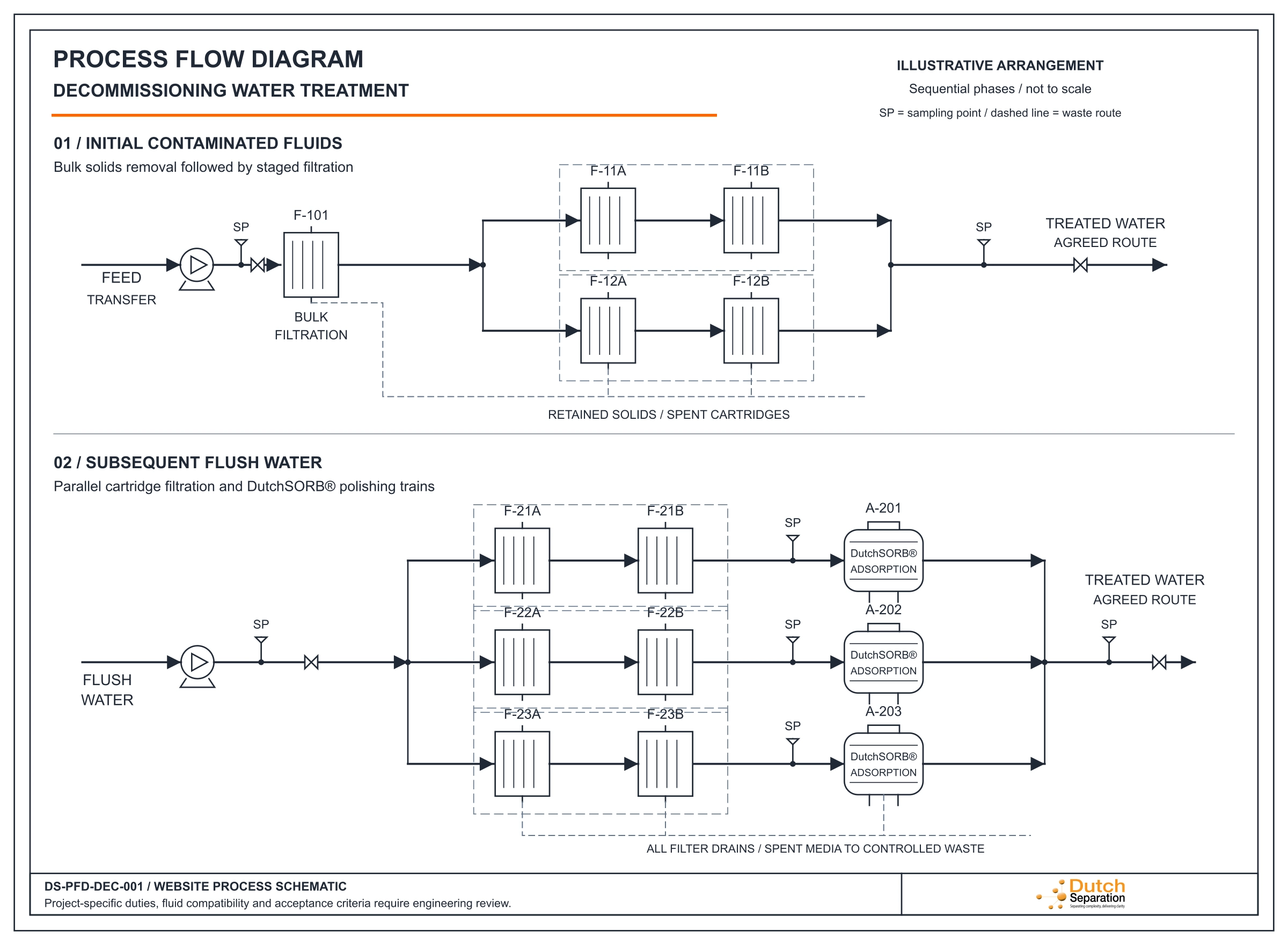
Dutch Separation decommissioning PFD: staged solids filtration followed by parallel cartridge filtration and DutchSORB® polishing. Illustrative arrangement; final duties require project-specific engineering. View the full-size PFD ↗
04 / MEASURED ACCEPTANCE
Sampling, waste segregation and a clear handover
Set the outlet specification and sampling method before mobilisation. An oil-in-water result measures one part of the water quality picture. Other contaminants, the discharge or reuse destination, and the applicable project permissions can require additional testing. Treatment equipment alone does not establish discharge approval. For UK projects, review the OPRED offshore environmental guidance with the duty holder.
Where NORM or LSA contamination is suspected, establish characterisation, specialist handling responsibilities and an authorised waste route before processing. Filtration can capture particulate scale; it does not demonstrate removal of dissolved radioactive constituents. Review H₂S and other site hazards through the project risk assessment. The US EPA overview of oil and gas NORM wastes explains why both water and retained deposits need characterisation.
Plan how retained solids, spent cartridges, exhausted media and drained residues will be contained and segregated. Agree cleaning, decontamination and equipment-return requirements early so the treatment plan extends through demobilisation. Operating records should connect treated volumes, process checks and sample results to the agreed acceptance criteria.
05 / PROJECT QUESTIONS
Offshore decommissioning water treatment FAQs
What can be treated during offshore decommissioning?
The proposed scope can include contaminated pipeline flush water, hydrocarbon-bearing cleaning water, slops and sludge. Suitability depends on representative analysis and a review of the treatment target, operating conditions and waste route.
When should DutchSORB® follow cartridge filtration?
Consider DutchSORB® adsorption where suitable residual dissolved contaminants remain after upstream solids removal. Cartridge filtration protects the adsorption stage from particulate loading. Media selection, contact conditions and replacement planning require a review of the actual fluid; the arrangement shown in the PFD is a starting point for engineering, not a universal treatment specification.
How is treatment capacity selected?
Use peak and average flow, total volume, solids loading and the expected duration of each treatment phase. Assess pressure loss, consumable demand and the space available for series or parallel arrangements. Confirm the achievable operating duty before mobilisation.
Can treated water be discharged offshore?
Only where the relevant permissions and agreed acceptance criteria allow it. Define sampling, analytical methods and the decision process with the project team. No universal discharge limit or guaranteed outlet concentration applies to every decommissioning stream.
What information should we provide for a proposal?
Send the project location and programme, representative analysis, total volumes, minimum and maximum flow, treatment target, available utilities and connection details. Include known NORM or LSA findings, other hazards, site access and the planned waste-disposal route.
YOUR NEXT PROJECT
Plan your decommissioning water treatment package
Start with your fluid analysis or sampling plan, expected volumes, flow range, project location and programme. Include the treatment target, available space and utilities, connection details and known hazards. The team can then review the filtration and DutchSORB® stages, identify missing information and define a project-specific scope.
Related expertise: industrial wastewater treatment · produced water treatment · equipment and process guide