DUTCH SEPARATION / TECHNICAL GUIDANCE
How Modular Wastewater Treatment Works
Modular wastewater treatment connects selected unit operations into a treatment train. Dutch Separation’s approach is to configure the process around the water stream and treatment target, define the interfaces, add capacity where required and redeploy suitable modules when the project changes.
Published 10 October 2026 · Dutch Separation
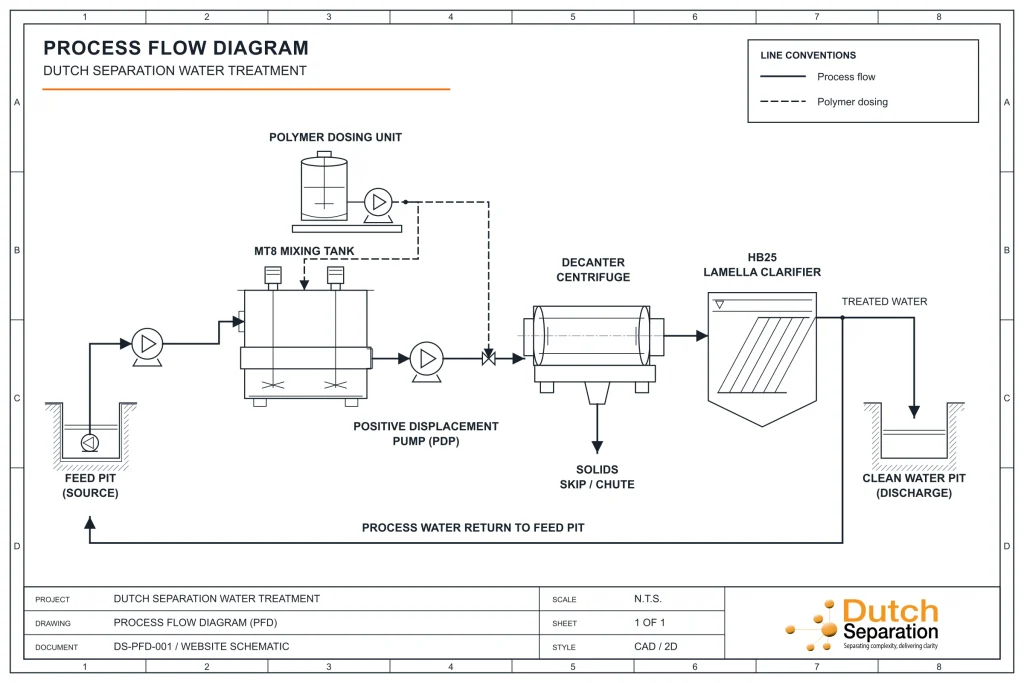
Illustrative Dutch Separation process flow diagram. The treatment sequence and return routes require project-specific review.
Configure modular wastewater treatment
Start with representative water analysis, expected flow variation and the required outlet quality. Establish which contaminants are suspended solids and which require a different treatment mechanism. Select unit operations for the actual duty rather than including every available module.
Our illustrated process concept shows a feed pit, mixing tank, polymer dosing, positive displacement pump, decanter centrifuge and lamella clarifier. Separated solids have their own discharge route, and the diagram includes a water return. It is a process explanation; each installation requires its own design review.
For modular wastewater treatment, an analysis should distinguish normal feed conditions from short-term peaks. Record where the samples came from and whether production or cleaning activities affect their composition. Translate the outlet requirement into measurable acceptance criteria, then identify which stage addresses each part of that requirement. This gives the proposed treatment train a clear basis for review.
Connect four interface types
Physical interfaces cover the footprint, lifting and access arrangements. Process interfaces cover feed, discharge, drains, pressure and material compatibility. Power interfaces cover the available supply and equipment demand. Control interfaces cover signals, interlocks and communication between modules.
Standardisation makes configuration easier when the selected equipment and site conditions fit the interface plan. Connections still need to be checked against the duty. Confirm utilities, pipework, drainage, alarms and safe access before mobilisation.
Create an interface schedule before mobilisation. For each connection, record its purpose, connection type, permitted operating conditions and the party responsible for installation. Include sampling points and the route for rejected water. The schedule should also identify which alarms stop an upstream feed and how the system will restart after an interruption.
Scale at the process bottleneck
Adding a module only increases useful capacity when the upstream and downstream stages can support the new duty. Review pumps, buffering, treatment stages, solids discharge and utilities together. A parallel arrangement may need flow balancing and revised control logic.
Define the required operating range before adding equipment. Where the feed or treatment target changes, reassess the process as well as capacity. Modular design supports adjustment, but sizing and performance must be established for the project.
Redeploy with a documented handover
Before moving equipment to another application, review material compatibility, cleaning requirements, equipment condition and the new process duty. Update the interfaces, operating instructions and agreed project documentation for the next installation.
Share the site location, analysis, flow range, treatment target, available utilities and project duration with Dutch Separation. We use these inputs to review the configuration and determine whether additional sampling or trials are needed.
A modular wastewater treatment handover should include a current process flow diagram, the agreed operating envelope, cleaning instructions and the scope of operator checks. Review these documents when a module is replaced or relocated. Keep the design assumptions with the equipment records so that a future project can assess what remains suitable and what must change.
Further reading
Related service guidance: industrial wastewater treatment, sludge dewatering and separation equipment rental. This guide explains the modular process shown on our website.
Explore the process.
Decanter Centrifuge vs Filter Press ↗ Separation Equipment and Process Guide ↗Define your separation duty.
Share the stream analysis, site location, flow range, treatment target and project duration. We will review the process requirements and identify the next step.
Discuss your separation challenge ↗