DUTCH SEPARATION / TECHNICAL GUIDANCE
Decanter Centrifuge vs Filter Press
A decanter centrifuge separates solids by centrifugal force in a rotating bowl. A filter press separates solids through filter cloth under pressure in a batch cycle. The practical choice depends on the material, required cake condition, liquid quality, operating pattern and site constraints.
Published 10 October 2026 · Dutch Separation
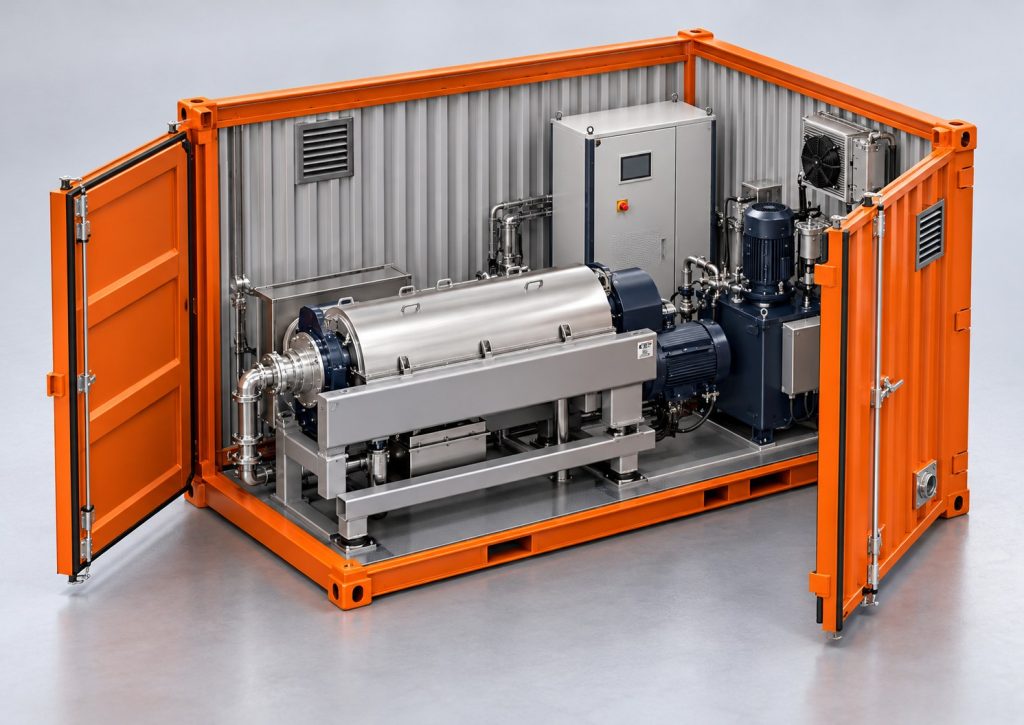
Dutch Separation decanter concept render. Final equipment selection and performance depend on the agreed duty.
Decanter centrifuge vs filter press: separation principles
In a decanter, a rotating bowl moves denser solids towards the bowl wall. A scroll rotating at a different speed conveys the settled solids towards the discharge. The clarified liquid leaves through a separate outlet. Feed characteristics and machine settings affect the separation result.
A filter press feeds slurry into chambers formed between filter plates. Liquid passes through the cloth while solids accumulate as cake. The cycle includes filling and filtration, followed by opening the press and removing the cake. Washing or other steps depend on the selected press and process.
Compare the whole operating duty
For a steady feed, evaluate how a decanter’s continuous separation fits the process, including feed control, polymer preparation, solids handling and downstream liquid treatment. Continuous operation still requires planned cleaning, maintenance and a route for the separated streams.
For a filter press, evaluate the complete batch cycle, cake release, cloth cleaning and storage between cycles. Compare throughput over the full cycle rather than peak pump flow. A buffer tank or multiple units may be needed when the upstream process runs continuously.
What to test before selection
Use representative samples to establish solids concentration, particle characteristics, settling behaviour and variability. Define the required cake condition and liquid outlet quality. Trials should compare achievable results at a realistic feed rate, including conditioning requirements.
For a decanter centrifuge vs filter press trial, record the same feed analysis for both routes. Include samples taken during normal operation and during expected changes in production. Agree how the cake and liquid samples will be collected, which laboratory methods will be used and what constitutes an acceptable result. This makes the comparison repeatable rather than relying on an isolated sample.
Review total operating effort: energy, consumables, cleaning, maintenance, operator time and disposal or reuse routes. Neither equipment name guarantees a specific result. Dutch Separation can review the duty as part of a sludge dewatering or equipment rental enquiry.
Compare the handling steps after separation too: storage, transfer, transport and the requirements of the receiving treatment or disposal route. A cake that looks dry may still behave differently during loading or storage. For liquid reuse, check the downstream process requirements rather than assuming that visually clear water is suitable.
A useful enquiry checklist
Share minimum and maximum flow, operating hours, temperature, solids concentration, analysis and any previous trial results. Describe the target cake handling condition, acceptable liquid quality and available utilities, access and space.
State whether the project is temporary or permanent and how the feed may change. This helps identify sampling, testing and interface work before an equipment configuration is agreed.
When reviewing decanter centrifuge vs filter press options, include start-up, shutdown, flushing and planned maintenance in the operating schedule. Identify who supplies consumables, who operates the unit and how off-specification material will be managed. Document these responsibilities alongside the trial results before confirming the equipment.
Further reading
Technical background: Flottweg — decanter functionality and ANDRITZ — filter presses. Manufacturer explanations describe the separation principles; they are not performance claims for a Dutch Separation installation.
Explore the process.
How Modular Wastewater Treatment Works ↗ Separation Equipment and Process Guide ↗Define your separation duty.
Share the stream analysis, site location, flow range, treatment target and project duration. We will review the process requirements and identify the next step.
Discuss your separation challenge ↗