
DUTCH SEPARATION / SERVICES
Sludge Dewatering Services
Dutch Separation provides sludge dewatering services built around your feed, solids-handling requirements and liquid treatment route. We review decanter centrifuges, filter press equipment and the surrounding pumping, mixing and dosing stages to configure a modular system for the project.
Discuss your project ↗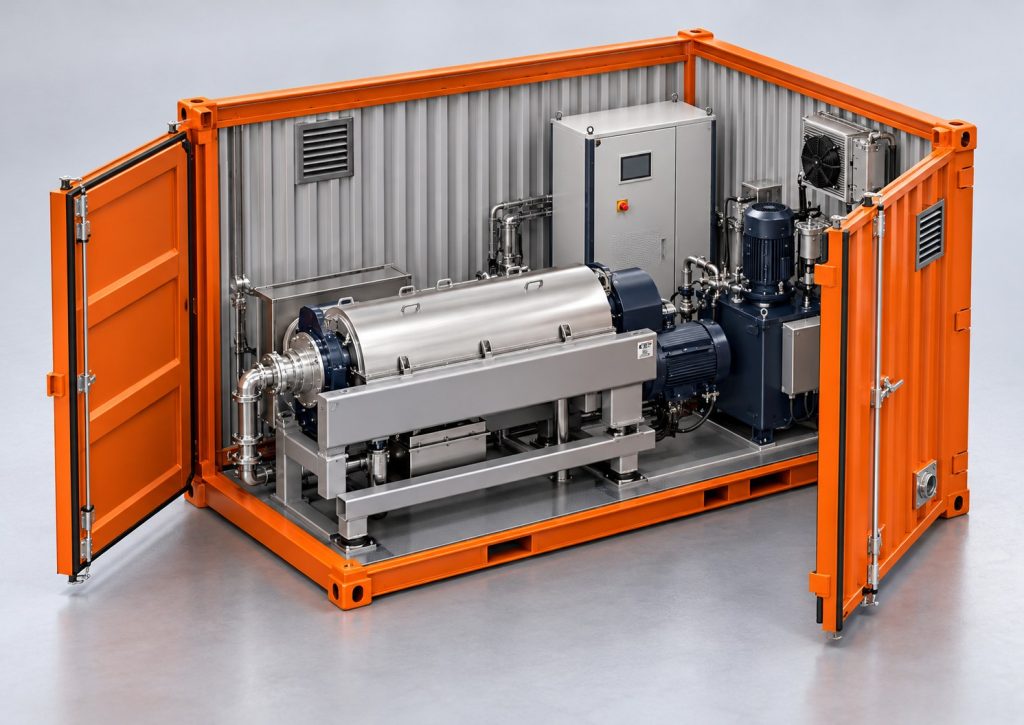
Concept render of a modular decanter centrifuge. Final equipment configuration is defined for each project.
01 / APPLICATION
Dewatering industrial sludge and solids-rich streams
Sludge dewatering concentrates a solids-rich feed into a solids fraction and a separated liquid. The starting point may be sludge from industrial wastewater treatment, a cleaning campaign or a decommissioning stream. Review solids concentration, particle behaviour, chemistry and variability before selecting equipment.
Define how the separated solids will be stored, moved and accepted by the next process or waste route. Assess the liquid outlet at the same time: a clearer appearance does not establish its suitability for discharge or reuse. The required solids consistency and liquid quality guide the selection and any testing.
02 / EQUIPMENT
Centrifuge and filter press configurations
A decanter centrifuge separates suitable solids and liquid continuously. A filter press uses a batch filtration cycle and needs provision for cake removal and filtrate collection. Compare the equipment against the same feed, operating hours, solids-handling objective and liquid outlet requirement. Neither machine has one capacity or dryness figure that applies to every sludge.
The complete configuration can include feed storage, mixing, a suitable feed pump, conditioning and polymer dosing, followed by solids and liquid handling. Review the differences in our decanter centrifuge versus filter press guide. Laboratory work or a practical trial may be appropriate before fixing the equipment and operating scope.
03 / PROJECT DELIVERY
Plan the complete dewatering duty
Review the feed volume and flow range alongside the solids loading, operating hours and storage available between process stages. Confirm footprint, access, lifting, power, wash water and drainage. Define who supplies the tanks, pumps, hoses and solids-handling equipment, and how the installation connects to the existing process.
Equipment supply or rental, commissioning, documentation and operational support can be included in the agreed project scope. Share the planned location, project duration and sludge information so that suitability and equipment availability can be reviewed.
Planning your project: frequently asked questions
Can you guarantee a dry solids percentage from an initial enquiry?
A reliable target requires material information and, where appropriate, testing. We do not publish a universal cake dryness or recovery figure because results depend on the sludge and operating conditions.
What happens to the separated liquid?
Collect and assess the separated liquid against its intended destination. It may return to the process or require industrial wastewater treatment. Agree sampling and acceptance criteria for both liquid and solids before operating; dewatering does not by itself demonstrate that the liquid can be discharged.
Can dewatering equipment be rented?
Rental can be considered for a suitable project duty. Equipment selection, availability, support requirements and the hire period are confirmed during the enquiry process.
What should a sludge dewatering trial measure?
Agree a trial plan covering feed solids concentration, throughput, conditioning and operating stability. Assess the solids fraction for the required handling behaviour and the liquid for the next treatment step. Record consumable use and the sampling method, and compare results under defined conditions. Use the findings to establish the project duty rather than applying one test result to every future feed.
How do site conditions influence sludge dewatering?
Access, lifting arrangements, feed storage and the destination of the dewatered solids affect the complete installation. The process also requires a review of the available electrical supply, wash water, drainage and operating space. Include the expected operating hours and any restrictions on deliveries or maintenance. These practical details help define a workable project scope, including who provides the surrounding tanks, pumps, hoses and handling equipment, before equipment is delivered to site.
Connected capabilities.
SEPARATING COMPLEXITY. DELIVERING CLARITY.
Plan your sludge dewatering duty
Send representative sludge analysis, total volume, flow range, operating hours and the required solids and liquid outcomes. Include the location, project duration, utilities and handling arrangements. We will review equipment suitability, whether a trial is needed and the scope for supply or rental.
Discuss your separation challenge ↗ info@dutchseparation.com